EDGRN → EDCMP: static deformation#
EDGRN computes static Green’s tables in a layered elastic half-space. EDCMP combines those tables for dislocation sources. The Python library workflow builds five basis dislocations and synthesizes static displacement, strain, stress or tilt at a query point.
Complete layered calculation#
python examples/edgrn_edcmp.py
The script runs four necessary steps: EDGRN preprocessing/calculation, EDCMP preprocessing/calculation using the same tables, format conversion, and displacement reading with explicit seismic-moment scaling.
"""Build layered EDGRN tables, use EDCMP, and plot static displacement."""
from pathlib import Path

import matplotlib.pyplot as plt
import numpy as np

from common import MECHANISM, MOMENT_NM, finish, parser_for, prepare
from pygrnwang.create_edgrn_bulk import pre_process_edgrn2, create_grnlib_edgrn2_sequential
from pygrnwang.create_edcmp_bulk import (
    pre_process_edcmp2, create_grnlib_edcmp2_sequential, convert_pd2bin_edcmp2_all)
from pygrnwang.read_edcmp import seek_edcmp2


def main():
    args = parser_for("edgrn_edcmp").parse_args()
    output, library, model, report, started = prepare(args, "EDGRN2 + EDCMP2")
    # Keep queries inside the table: finite-source corners can cross its edges.
    distances = [30.0, 60.0, 90.0]
    # EDGRN requires at least two source depths, even for one queried depth.
    grid = dict(processes_num=1, path_green=library,
                grn_source_depth_range=[10.0, 11.0], grn_source_delta_depth=1.0,
                grn_dist_range=[0.0, 120.0], grn_delta_dist=30.0,
                obs_depth_list=[0.0])
    if not args.reuse:
        pre_process_edgrn2(**grid, path_nd=model, earth_model_layer_num=24,
                          wavenumber_sampling_rate=12)
        create_grnlib_edgrn2_sequential(library)
        # Same geometry and root: EDCMP consumes the EDGRN tables from step one.
        pre_process_edcmp2(**grid, output_observables=(1, 0, 0, 0), layered=True)
        create_grnlib_edcmp2_sequential(library)
        # Serial EDCMP does not perform the bulk conversion automatically.
        convert_pd2bin_edcmp2_all(library, remove=False)
    # EDCMP normalizes the mechanism to M0=1. Scale its result explicitly.
    values = np.asarray([MOMENT_NM * seek_edcmp2(
        path_green=library, event_depth_km=10.0, receiver_depth_km=0.0,
        az_deg=30.0, dist_km=distance, focal_mechanism=MECHANISM,
        rotate=True, output_type="disp", times_mu=False, model_name=str(Path(library) / "noQ.nd"),
    ) for distance in distances])
    if values.shape != (3, 3) or not np.isfinite(values).all() or not np.any(values):
        raise AssertionError("Invalid static displacement output")
    labels = ["E", "N", "U"]
    np.savez_compressed(output / "disp.npz", values=values, distance_km=distances,
                        components=labels, unit="m")
    fig, axis = plt.subplots(figsize=(8, 4), constrained_layout=True)
    for index, label in enumerate(labels):
        axis.plot(distances, values[:, index], "o-", label=label)
    axis.set(xlabel="Epicentral distance (km)", ylabel="Static displacement (m)",
             title="EDGRN2 + EDCMP2, M0 = 10^15 N m")
    axis.ticklabel_format(axis="y", style="sci", scilimits=(-2, 2))
    axis.legend()
    axis.grid(alpha=0.2)
    fig.savefig(output / "disp.png", dpi=140)
    plt.close(fig)
    report["outputs"]["disp"] = {"shape": list(values.shape), "components": labels,
                                  "unit": "m", "finite": True,
                                  "peak_absolute": float(np.max(np.abs(values)))}
    report.update(distances_km=distances, earth_model_numeric_rows=24, source_grid_km=[10.0, 11.0], distance_grid_km=[0.0, 30.0, 60.0, 90.0, 120.0])
    finish(output, report, started)


if __name__ == "__main__":
    main()
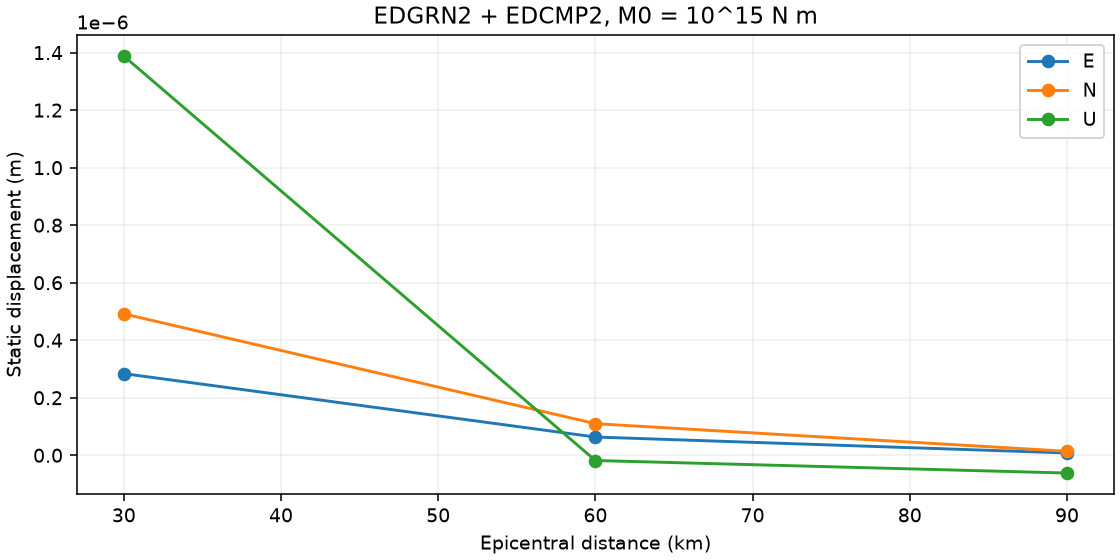
Static displacement in metres. There is no time axis or sampling interval.#
The model uses the first 24 numeric rows. EDGRN requires at least two source depths, so the library contains 10 and 11 km and the example queries 10 km. Both stages use distances 0, 30, 60, 90 and 120 km, while plots query the interior 30/60/90 km points. The extra margin avoids finite-dislocation geometry crossing the table boundary.
The default output is examples/output/edgrn_edcmp/ with disp.npz,
disp.png and summary.json. The saved array has shape (3, 3):
one E/N/up vector per queried distance.
Parameters and two-stage consistency#
Keep source depth range/increment, receiver depth list, distance
range/increment and root directory consistent between EDGRN and EDCMP.
The wrappers accept km and convert the backend inputs to metres.
wavenumber_sampling_rate controls EDGRN numerical integration;
converge it for your geometry and material model.
layered=True makes EDCMP use EDGRN’s edgrn.ss, edgrn.ds and
edgrn.cl. The low-level EDCMP writer also has a homogeneous half-space
mode with layered=False and lam/mu in Pa. Layered mode uses a
1 m × 1 m rectangle with 1 m slip. Half-space mode uses a unit-potency
point source (1 m³, Okada’s DC3D0). The complete tutorial
uses the layered mode and the model-based normalization.
The four output_observables positions are displacement, strain,
stress and tilt. The example selects (1, 0, 0, 0). To build another
quantity, enable its flag before calculation and request its corresponding
output_type from the reader.
Normalize the static response#
EDCMP readers normalize a supplied mechanism to scalar moment 1, regardless
of whether the mechanism contains an explicit M0. The example requests
the default times_mu=False kernel and then multiplies by 10^15 N m.
The material lookup must receive the generated four-column noQ.nd,
not the six-column propagation model. Passing the latter can produce an
incorrect modulus through the low-level reshape without a useful error.
The script supplies the correct material file.
Alternatively, times_mu=True retains unit-slip, unit-area basis values.
Combined with area_km_sq=A and an external slip factor in metres, it
gives the corresponding dislocation response. The bulk reader also accepts
slip_m_arr. Do not multiply that area/slip-scaled result by M0 again.
See the full normalization contract.
check_convert_pure_dp=True projects source shape to a double couple.
Disabling it preserves a normalized tensor shape within the five-basis
representation; it does not restore input magnitude or create an
isotropic-source basis.
Files and result interpretation#
EDGRN writes under edgrn2/<receiver>/; EDCMP writes five source-basis
directories under edcmp2/<source>/<receiver>/. The sequential EDCMP
builder does not call the bulk converter automatically, so the script
explicitly invokes convert_pd2bin_edcmp2_all. The converted whole-grid
files are also needed for seek_edcmp2_bulk.
Single queries return vectors: length 3 for displacement, 6 for strain/stress and 2 for tilt. Rotated strain/stress order is EE/EN/EU/NN/NU/UU; unrotated order is RR/RT/RZ/TT/TZ/ZZ. Tensor strain is dimensionless, stress is Pa and tilt is rad after the appropriate amplitude scaling.
These are static results, not the final sample of a dynamic waveform with an arbitrary time window. A comparison with dynamic late-time response requires matching source normalization, half-space physics, converged low-frequency content and a sufficiently long trace.